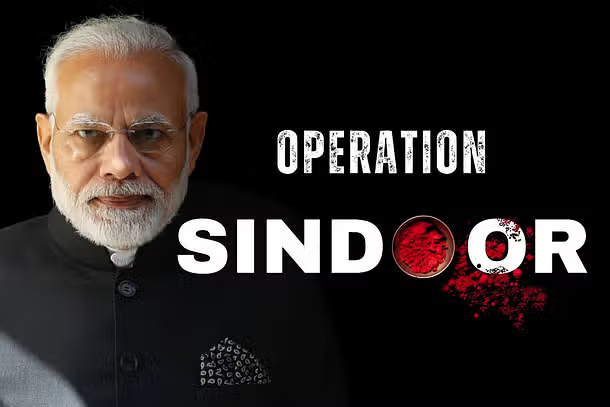
India’s Operation Sindoor Explained! and Why are India and Pakistan going to War?

The Indian government has launched precision strikes on 9 terrorist hideouts located in Pakistan, with an estimated 40 militants believed to have been killed. The mission has been officially named Operation Sindoor.

India’s Operation Sindoor:

The Meaning:

Operation Sindoor carries deep cultural significance. In Indian society, sindoor is a traditional red vermillion powder applied by a husband on his wife’s forehead during marriage ceremonies, symbolizing her marital status. A woman is considered married only after this ritual is performed.

The operation was named Sindoor in reference to the tragic events of the April 22, 2025, terror attack in Pahalgam, where Pakistani terrorists brutally gunned down around 26 unarmed Indian civilians. Many of the victims were married men, leaving their wives widowed—women who, according to tradition, can no longer wear sindoor.

This name serves both as a tribute and a powerful reminder of the lives lost and families shattered by the attack.

Press Release on Operation Sindoor:

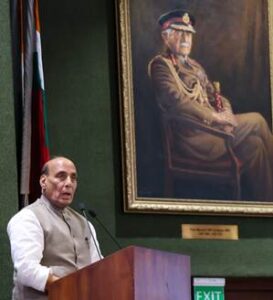
“Through Operation Sindoor, India exercised its right to respond to the attack on its soil,” said Defense Minister Shri Rajnath Singh, addressing the 66th Raising Day of the Border Roads Organisation (BRO) at the Manekshaw Centre, Delhi Cantt, on May 7, 2025.

He praised the Armed Forces for executing the mission with precision, caution, and compassion, successfully destroying terrorist training camps located in Pakistan and Pakistan-occupied Kashmir (PoK). The Defense Minister emphasized that all planned targets were eliminated without causing harm to any civilian population.

Shri Singh also lauded the Armed Forces for delivering a strong and appropriate response under the leadership of Prime Minister Shri Narendra Modi.

“The entire world has witnessed the decisive action taken by our Armed Forces today,” said Defense Minister Shri Rajnath Singh. The operation was carried out with careful planning and deliberate restraint, targeting only terrorist training camps and related infrastructure with the specific intent of breaking their morale.

On behalf of the entire nation, I extend my heartfelt congratulations to our Armed Forces. I also commend Prime Minister Shri Narendra Modi for his unwavering support and leadership throughout this mission.
Why are India and Pakistan going to War?

1. Kashmir Dispute: Main Reason

The Kashmir region remains the focal point of India-Pakistan tensions. After the partition of British India in 1947, the princely state of Jammu and Kashmir, with a Muslim-majority population, was granted autonomy and given the option to join either India or Pakistan. The then-Maharaja Hari Singh chose to accede to India, a decision that led to immediate conflict between the two newly formed nations. Both India and Pakistan claim the region in its entirety, but each controls only parts of it, resulting in multiple wars and continuing skirmishes.

In 1947-48, the first India-Pakistan war broke out, and the United Nations brokered a ceasefire, dividing Kashmir into Indian-administered and Pakistani-administered regions. The Kashmir conflict remains unresolved, with frequent clashes along the Line of Control (LoC), where both countries maintain heavily militarized borders.

“The Kashmir issue is not just a territorial dispute; it’s a battle of identity for both India and Pakistan, with Kashmir at the heart of their self-image.” A.G. Noorani

2. Terrorism:

The issue of terrorism, especially cross-border terrorism, has been a major flashpoint in the India-Pakistan conflict. India accuses Pakistan of harboring and supporting militant groups that conduct terrorist activities, particularly in Kashmir. Groups like Lashkar-e-Taiba (LeT) and Jaish-e-Mohammed (JeM) have been responsible for numerous attacks on Indian soil, heightening the already fragile relationship between the two countries.

In 2001, the Indian Parliament was attacked by terrorists, leading to a major military standoff between India and Pakistan. The 2008 Mumbai attacks, orchestrated by LeT, killed 166 people and further escalated tensions. India has consistently held Pakistan responsible for supporting these militant groups, while Pakistan denies any state involvement.

“The terror attacks in India are a symptom of the deeper issue in Pakistan—an identity crisis where the military and intelligence agencies continue to see India as the enemy, and Kashmir as the ultimate goal.” Bruce Riedel

3. Nuclear Powers:

The nuclearization of India and Pakistan has added a dangerous dimension to their rivalry. Both nations conducted nuclear tests in 1998, making South Asia one of the most volatile nuclear flashpoints in the world. While nuclear weapons have acted as a deterrent to full-scale war, they have also fueled an arms race and increased the potential for catastrophic escalation.

The 1999 Kargil War, in which Pakistani forces attempted to infiltrate India’s territory in Kashmir, is a prime example of how military skirmishes can escalate quickly. Although nuclear deterrence prevented an all-out war, the conflict demonstrated how fragile peace is in the region, particularly when nuclear weapons are involved.

“The nuclearization of the India-Pakistan rivalry presents the world with a dangerous paradox: nuclear weapons may prevent war, but they also make war more catastrophic.” Henry Kissinger 

4. Nationalism:

In 2019, following a terrorist attack in Kashmir, India retaliated with an airstrike on terrorist camps in Pakistan. This marked a significant military escalation, but both sides stopped short of declaring war. The rhetoric of nationalism and revenge plays a large role in such escalations.

“The legacy of partition runs deep in both countries, and the national narratives constructed in India and Pakistan ensure that the memories of 1947 continue to shape their politics. The tragedy is not just historical—it’s alive in every act of violence.” Arundhati Roy

5. Breakdown of Peace Talks:

The Lahore Declaration (1999) and the Shimla Agreement (1972) are two notable examples of failed attempts to resolve the Kashmir dispute. The breakdown of these agreements often leads to renewed military tensions, further eroding the trust between the two nations.

“We will talk to Pakistan only if they stop exporting terrorism. There can be no meaningful dialogue when one side continues to promote violence.” Sushma Swaraj


The Government of India has classified Operation Sindoor strictly as an anti-terror operation. While it may be viewed as a violation of Pakistan’s sovereignty, Indian officials have stated that it was a direct and justified response to the Pahalgam terror attack.

Given Pakistan’s widely recognized role in harboring terrorist groups, the operation has received a generally positive reaction from the international community, including the United Nations. India has consistently maintained a Zero Tolerance policy toward terrorism, and this operation reflects its unwavering commitment to that stance.


Leave a Comment