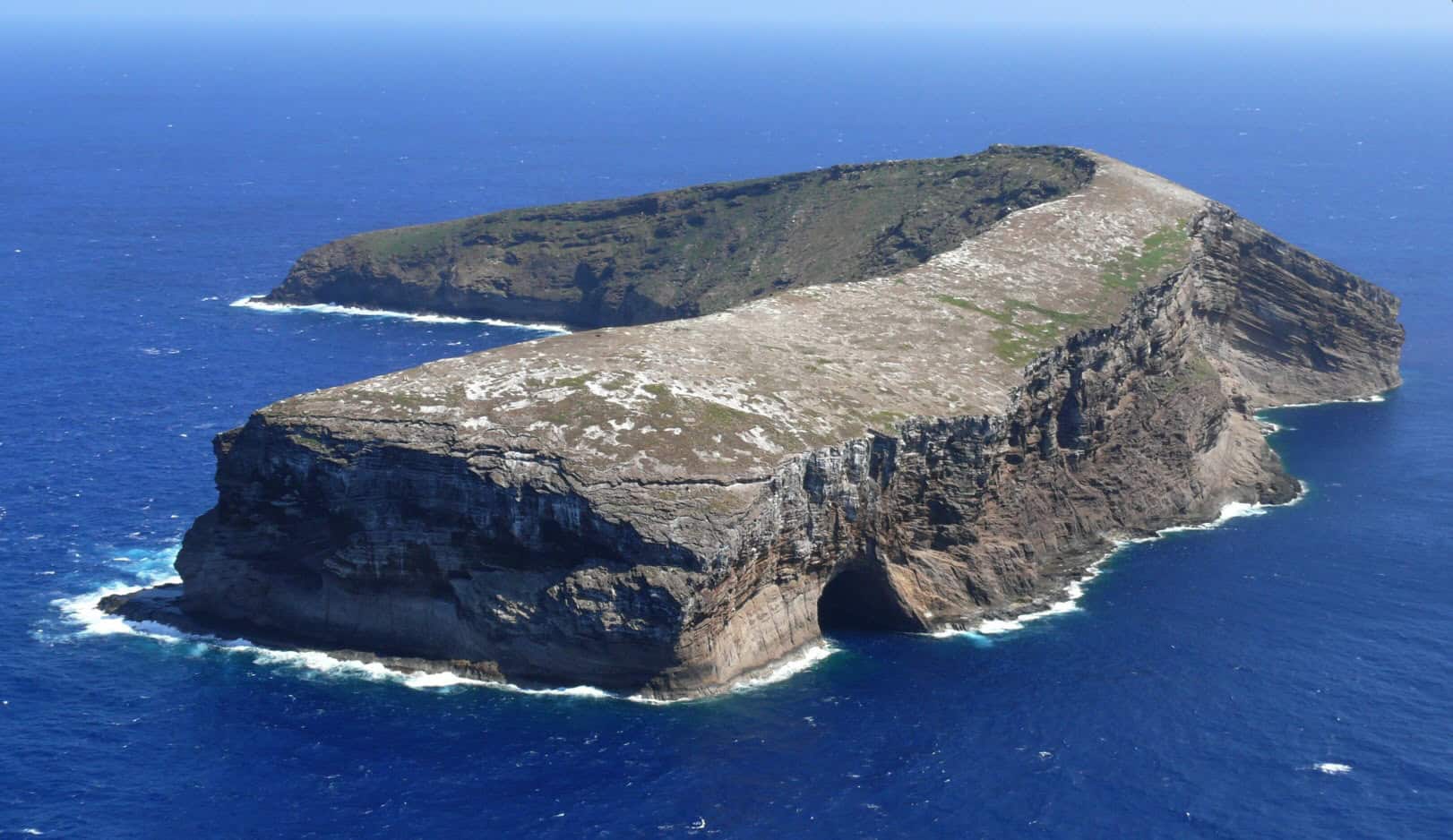
Why is the military dropping 500-pound bombs near sacred Hawaiian waters? A quiet island off Niʻihau has become the latest flashpoint in the battle between national defense and native preservation.
Kaʻula Island, Hawai‘i — June 2025
A remote, crescent-shaped islet off the coast of Niʻihau has recently taken center stage in a growing controversy that pits national defense practices against environmental preservation and cultural reverence. Kaʻula Island, largely unknown outside of fishing and cultural circles, is once again being targeted by the U.S. military for bombing exercises — and this time, Hawai‘i’s congressional delegation is pushing back.
A Long-Shrouded Practice
Located about 23 miles southwest of Niʻihau, Kaʻula Island has been used by the military since the 1950s for aerial target practice. Exercises involve the dropping of 500-pound dummy bombs, primarily by naval aircraft. While the bombs are non-explosive, the environmental and ecological impact of repeated strikes is increasingly coming under scrutiny.
Despite its status as a bombing range, Kaʻula is officially listed as a State Seabird Sanctuary. The U.S. Fish and Wildlife Service (USFWS) has reported that the island hosts a range of nesting seabirds, including wedge-tailed shearwaters, brown boobies, and red-footed boobies. In 2023, the USFWS estimated that Kaʻula supports over 15,000 nesting seabirds annually, making it one of the most significant seabird habitats in the Hawaiian archipelago.
The dual designation as both a wildlife refuge and military target zone has long fueled tension between federal and local interests.
Congressional Scrutiny
In May 2025, U.S. Senators Brian Schatz and Mazie Hirono, along with Representatives Ed Case and Jill Tokuda, issued a formal request to the Navy demanding a full Environmental Impact Statement (EIS). The request followed reports that the military intended to expand its use of Kaʻula for more frequent training missions.
“The public deserves transparency when it comes to the use of our natural and cultural resources,” Senator Schatz said in a statement. “An Environmental Impact Statement is the minimum requirement.”
Representative Ed Case added, “Kaʻula is not just a rock in the ocean. It is part of our living natural heritage and demands proper stewardship.”
Military officials maintain that the site offers “critical training advantages” and is uniquely positioned for Pacific-based defense preparedness. In a 2024 Department of Defense readiness report, Kaʻula was cited as a “strategically isolated target with minimal risk to population centers,” suitable for live and inert ordnance testing.
However, details surrounding past exercises have been vague, prompting accusations of secrecy and a lack of public accountability. In 2022, a Government Accountability Office (GAO) report on Pacific training ranges criticized the Department of Defense for failing to update environmental compliance documentation on multiple Hawai‘i-based sites, including Kaʻula.
Environmental and Cultural Stakes
Environmental groups warn that the continuous use of Kaʻula for bombing practice could have irreversible impacts on seabird populations, coral ecosystems, and marine biodiversity. Marine biologist Dr. Nohea Paik, who studies reef systems off Niʻihau, explained: “Even non-explosive ordnance creates physical damage, disturbs wildlife, and introduces foreign materials into delicate ecosystems.”
A 2021 study by the Hawai‘i Institute of Marine Biology found significant coral scarring and reduced fish biomass in waters adjacent to former bomb impact zones in the Pacific. Similar effects are feared for Kaʻula if bombing continues unchecked.
Cultural practitioners argue that Kaʻula holds spiritual significance. While not populated, it is regarded as part of a sacred seascape essential to traditional navigation and oral history. Uncle Kaleo Kapule, a respected Hawaiian elder, emphasized: “This island is not empty. It carries mana. Bombing it is an insult to our ancestors.”
He continued, “Our kupuna sailed by the stars, and Kaʻula was a landmark in the ocean. It guided our people. How can we let it be desecrated in the name of training?”
Joint Base Pearl Harbor-Hickam, Hawaii: Navy and Air Force hub. 2,700 acres. Hosts 160 aircraft, 15 ships, including submarines, destroyers. Supports 18,000 personnel. Key for Pacific ops, logistics, air refueling missions. pic.twitter.com/Xh66RwSOuz
— Vet Salutes 🇺🇸 🫡 (@VetSalutes) May 31, 2025
Legal and Historical Context
The use of Kaʻula for military purposes is permitted under a long-standing agreement, but critics argue that past environmental assessments are outdated. The last comprehensive EIS for the island was completed in 1993. Legal experts suggest that any attempt to increase bombing activity without a new EIS may violate the National Environmental Policy Act (NEPA).
The Center for Biological Diversity filed a petition in 2024 demanding that the Navy conduct an updated EIS before resuming any intensified operations, citing potential violations of the Migratory Bird Treaty Act and Endangered Species Act.
What’s Next?
With growing public interest and media coverage, pressure is mounting for the Department of Defense to reassess its Kaʻula operations. Environmental advocacy groups, including the Sierra Club of Hawai‘i and Protect Kahoʻolawe ʻOhana, are organizing petitions and planning public forums to raise awareness. A June 2025 rally in Honolulu is expected to draw thousands.
Meanwhile, lawmakers have vowed to continue pressing for full disclosure and accountability.
“Hawai‘i is not expendable,” said Representative Jill Tokuda. “We must protect our islands, not just for our generation, but for those to come.”
Brief
The debate over Kaʻula Island encapsulates broader questions about the balance between national security and environmental responsibility, between strategic interests and cultural preservation. As Hawai‘i stands at the crossroads of geopolitics and tradition, the bombs dropped on Kaʻula may well reverberate far beyond its rocky shores.
You Can Read This Also:
The Silent Invasion: How Space Tourism Threatens Native Hawaiian Lands and Culture?